Showing posts with label smart meters. Show all posts

Friday, 11 March 2022

SMETER – measuring the energy performance of a house

I think we all realise that home EPCs are not always accurate in predicting energy bills for a house. This is a shame for a lot of reasons. It makes it hard for the government to form housing policy: how do we assess potential energy savings from energy efficiency measures on the housing stock, if we don’t know how bad it is already? It is a shame for people looking to rent or buy a home who want to know what they are letting themselves in for. So why don’t we just measure the energy efficiency instead? Would that it were that simple. The government is well aware of the problem and has provided financial support for some potential solutions making use of smart meter data. The project was called SMETER (Smart Meter Enabled Thermal Efficiency Ratings). The results were promising but not brilliant. Here I explain why it is so hard, and some of the solution strategies.

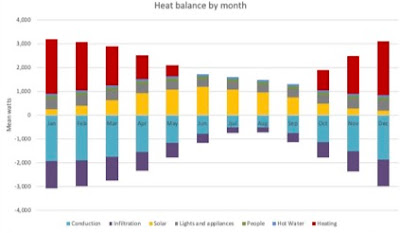
Whether you are modelling or measuring, the core of the problem is the balance of heating coming in and heat going out. This chart captures the balance from a model of a typical semi detached house with filled cavity walls, double glazed windows and 100mm loft insulation, in the East of England. The model is similar to that used for calculating EPCs. The chart shows month by month heat losses (blue and purple, downwards) through conduction through walls etc and air leakage, balanced by heat gains including solar gains through windows, use of electrical appliances, heat losses from the hot water system (mainly from hot water pipes distributing heat around the house) and of course the heating. 


Friday, 28 July 2017

What does a sustainable energy system for 2050 look like?

The National Grid recently published their annual 'Future Energy Scenarios' report which describes alternative futures for electricity and gas supply and demand to 2050. There are four scenarios of which only one satisfies our carbon commitments but I am struck by how similar they are in terms of electricity generation - where they differ greatly is in gas demand and use of smart technologies to manage infrastructure - including smart meters and time of use pricing.

Wednesday, 15 February 2017

No, smart meters will not make you ill

I was recently invited to sign a 38 degrees petition against smart meters primarily on health and safety grounds. This made all sorts of spurious claims about the health impacts of radio waves used to propagate smart meter data. A friend who also got the same invite wasn't sure what to believe and another acquaintance seems to be convinced that the government and utility companies are conspiring to make us all ill with smart meters. This is ridiculous.

Thursday, 5 January 2017

What would a smart time of day tariff do for me?

Green Energy UK has just announced a new electricity tariff called TIDE which varies by the time of day [1]. For many people this will save money because the tariff is cheap at weekends. The time to avoid is 4-7pm on weekdays when electricity costs are higher. It is hard to know what this would mean for your particular household unless you have detailed knowledge of your electricity use. If you have a smart meter this information ought to be available but your in house display probably is not clever enough to give it to you - you need more advanced viewing tools. In this post I use electricity use profiles from a detailed study of different kinds of households to see what the costs would be.

Tuesday, 11 October 2016

My flood story - why we need smart water meters too

I am somewhat obsessive about energy use and read our meters weekly, as I have said before. But I am not so diligent regarding water use. If I was, I could have saved us £100s on our water bill due to a massive leak we did not notice!
Our water bills should say:
Your consumption:

This period: 230 litres/day
Last period: 200 litres/day

Your consumption has increased 15%

Saturday, 10 September 2016

How to make sense of your meter readings - and make them useful

I have been taking gas and electricity meter readings on a regular basis for about 5 years now and I can use this data to make some pretty graphs, showing energy use through the year. However, heating energy depends on the weather which makes year by year comparisons rather meaningless. Adding in temperature data as well makes it much more interesting and genuinely useful.

Sunday, 24 July 2016

Never mind the EU - we still need smart meters

Now that we are leaving the EU we don’t have to go ahead with the smart meters rollout [1]. However, the reasons why smart meters were proposed in the first place have not gone away. Smart meters are vital for a truly responsive electricity market. British Gas are leading the way on this, offering their smart meter customers free electricity at weekends, when demand is normally low [2].

Smart meters get a bad press because they don’t save much money by themselves. However they are a vital bit of technology that enables a whole raft of other savings possibilities.

Monday, 16 March 2015

Would you like to save energy - and money - without having to think about it?

A survey conducted by UCL has found that more than a third of us would agree to letting energy companies adjust the thermostats in our homes remotely if we had reductions in our bills in return [1]. This option was the most popular of five, including having a 3-level time of use tariff (peak, mid-range, off-peak) at fixed times and another 3-level tariff with varying times depending on the weather. The reason would appear to be that the remote control tariff is the easiest to use. We wouldn't have to think about it at all.

Friday, 18 October 2013

Should you get an electricity monitor to help reduce your bills?

I was on the radio this morning (BBC Radio Cambridgeshire) talking about electricity monitors and energy savings at home. I didn't have time to say everything I wanted to say, so here is a summary.

Most people who get an electricity monitor find they can reduce their energy use by 5-15%. I have posted on this subject before: Turning energy monitoring into energy savings - but that post is a bit old and things have changed a bit.

Monday, 22 April 2013

How much for an itemised electricity bill?

Can you imagine going to the supermarket and filling your trolley with stuff without prices on and then getting a bill for the total and never knowing how much you could save by making different choices? Of course not, but that is what we do when we pay our electricity bill. We have little idea how much of that bill is due to the TV, or the fridge-freezer, or the washing machine, or the lights, the wifi router,... There are lots of websites which will try to give you some clues (some listed below) but in practice it is impossible to know without measuring, which means a lot of expensive special plugs and/or wiring. An average fridge uses 162 kWh/year but yours could use half this or double or more[1]. In fact there is a much easier way to get a partial answer by monitoring the whole house electricity use at least every second. Looking at the total power draw you can pick out 'events' when items are switched on and off and it is possible to recognise at least the most important appliances like TVs, washing machines, fridges and freezers and how much energy they are using. Would you like to know this? How much would you like it?