Showing posts with label carbon storage. Show all posts

Sunday, 6 August 2023

What happens to the wood we grow?

A recent article in New Scientist, and the peer reviewed paper behind it [1], opened my eyes to the staggering amount of wood from managed forests that goes up in smoke, if not immediately then after quite a short lifetime as something useful. This is a shame, given the potential for using wood to store carbon. The article includes a rather fine flow digram of what happens to the wood we cut at the global level. I have compared these figures to what happens in the UK using data produced for the government by Forest Research [2]. A great deal less of our wood is used immediately for fuel, but rather more of it is used for short lived uses like fencing or paper/packaging. How can we increase the value of wood for carbon storage?

Flow diagram of how wood is used globally.

Flow diagram from [1] showing what happens to wood harvested from plantations. The figures are global averages based on 2010. Roundwood is logs, or other parts of trees removed from the forest in any form. OSB is oriented strand board.

Monday, 14 June 2021

How clean is 'clean' coal?

The G7 summit has agreed to to move away from making electricity from coal plants, unless they have technology to capture carbon emissions [1]. What does this mean in terms of greenhouse gas emissions? Carbon capture and storage  (CCS) is not a perfect solution, sadly. From my calculations, taking into account upstream emissions,  the emissions from a coal power station even with CCS are worse than those for UK grid average electricity now and with little hope of further improvement. In 2019 a little more than a third of UK electricity was from renewable and this continues to increase.  Of course the UK is not representative of the global average, but it shows what is possible, even starting with legacy power infrastructure. By 2050, average UK grid emissions should be down another 90%, but this may not be possible if much of our power comes from coal with CCS. Natural gas with CCS would be more sensible.


Comparing emissions from current UK coal and gas power stations, the same with CCS and average grid emissions. Coal with CCS is slightly worse than grid average, gas with CCS is considerably better. Estimates include emissions upstream of the power station. Data sources and assumptions are described below.

There are several reasons why clean coal is less than 100% clean:
  • There are upstream emissions, from mining and handling the coal before it gets to the power station.
  • Carbon capture at the power station does not catch all the carbon.
  • Carbon capture uses energy which makes the power station less efficient - so you need more coal (and hence more emissions) to make the same amount of energy.

Monday, 18 November 2019

Trees and carbon storage

Tree planting seems to be a hot topic in the election at the moment, with the Tories and the Lib Dems both offering lavish promises. The Committee on Climate Change also advises tree planting. How much difference will this make to climate change? How much carbon is stored in a tree, or in an area of forest and how much is added to this each year? Read on for the answers.

Friday, 28 July 2017

What does a sustainable energy system for 2050 look like?

The National Grid recently published their annual 'Future Energy Scenarios' report which describes alternative futures for electricity and gas supply and demand to 2050. There are four scenarios of which only one satisfies our carbon commitments but I am struck by how similar they are in terms of electricity generation - where they differ greatly is in gas demand and use of smart technologies to manage infrastructure - including smart meters and time of use pricing.

Thursday, 17 November 2016

Converting the gas grid to hydrogen, starting with Leeds.

Low carbon electricity is within our sights but low carbon heating is more difficult. Most UK homes use natural gas (methane) and switching to renewables (electricity or biomass) is expensive, even when it is practical. Northern Grid Networks (NGN) have another suggestion - converting the gas grid to supply hydrogen.  This is carbon free at the point of use but not usually where it is made - the NGN proposal is to convert from methane and sequester the carbon stripped off. This will give, at their estimate, 59% reduction in emissions. However once have we have a hydrogen distribution network other options, including carbon negative ones are possible. The big questions is, is it practical to convert the grid to hydrogen? NGN propose that we use Leeds as a pilot city and they have produced a detailed plan: H21 Leeds City Gate. They have convinced me that it is technically possible, and the biggest barrier is cost, but even this is not ridiculous compared to other means for carbon savings. The diagram below shows the concept.

Overall concept for H21 - including gas supply to the steam reformers, salt caverns for storage and hydrogen pipelines. In the city hydrogen would flow through the existing gas distribution network. Image 1.6 from [1].

Wednesday, 17 August 2016

The Hempcrete Book - review

The Hempcrete Book: Designing and building with hemp-lime by William Stanwix and Alex Sparrow. Green Books.
Hempcrete is an alternative building material with excellent sustainability credentials. It can be used instead of masonry or SIPs to build walls and to insulate roof and floors. If you are thinking of an eco building project you should at least consider using hempcrete for the construction – and in that case you should definitely read this book. It is an easy and fascinating read with a huge amount of advice about what hempcrete is good for, how to use it and other important details such as how to deal with building control. (Most council building inspectors have little knowledge of it so you are usually better off employing an authorised inspector who does.)

Saturday, 7 November 2015

Is landfill best for plastics?

I used to think that landfill is the best way to dispose of most plastics on the grounds that when plastics go into landfill they stay there - it is a form of carbon sequestration. On the other hand when plastic made from fossil fuels rots in soil or is incinerated, the net result is the same as burning the fuel and contributes to climate change. Since the plastic has come from the ground the best way to finish with it is to put it back into the ground. The main problems with plastic are due to the stuff that doesn't get into landfill - the stuff that litters the environment, contaminates the oceans and kills wildlife. However, from reading a report from ENSO Plastics on plastics disposal [1] I have come to realise that plastic in landfill is unlikely to remain pristine for thousands of years. Nature is incredibly resourceful and we keep finding examples of bugs and microbes that have evolved to consume plastic that was not supposed to be biodegradable [2][3][4]. So what is the best way to dispose of plastic materials?

Wednesday, 5 November 2014

What do IPCC emissions budgets mean?

The new IPCC synthesis report recommends we use total greenhouse gas (GHG) budgets instead of emission targets. This is better because it turns out that the global warming we can expect is more or less a linear function of the total GHG emissions we produce, regardless of when it happens. For a 66% chance of keeping below 2C warming we get a total emissions budget (since 1870) of 2900 Gt CO2e. We already emitted 1900 Gt up to 2011 so we have 1000 Gt left in the budget. The current rate of emissions is about 45 Gt/year. At this rate we would use our whole budget by 2033 - but it is supposed to last us forever. At the moment we are increasing emissions not decreasing them but at some point we have to reduce our net carbon emissions to zero. The later we leave it, the faster we will have to reduce. [1]

Monday, 9 July 2012

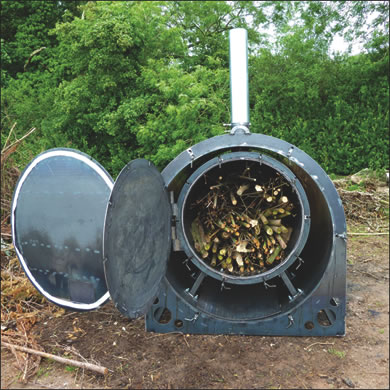
Whatever happened to biochar?

From http://www.biocharretort.com
I have been reading 'Ten Technologies to Fix the Planet' by Chris Goodall which is a little bit out of date now (it was published in 2008) so it is interesting to see how the technologies he recommended are faring. The one which seems to be going absolutely nowhere is biochar – capturing carbon by heat treating biomass and mixing it into soil. Carbon created this way can stay in the soil for centuries and improves fertility in a number of ways, not least by improving its water holding properties and drought tolerance.

Chris says: ‘..making charcoal is easy and can be done profitably by poor farmers in the tropics,’ and he reports on a trial in Cameroon where subsistence farmers added biochar to corn plots and significantly increased yields, up to double the normal.

Soils hold enormous quantities of carbon: 1600 billion tonnes globally, according to Goodall which is twice that in plants and trees and 200 times as much as we generate from fossil fuels each year. We could add a great deal of carbon to the soil without making much overall difference to the carbon cycle. Also biochar can be made very cheaply. So – how come we still can’t invest in biochar for carbon offsetting as I suggested in my post last year Carbon offsetting - does it really work?

Sunday, 7 August 2011

Carbon offsetting - does it really work?

My beloved asked me about carbon offsetting for airplane flights (maybe he's hankering after a long haul holiday journey after several years of no-fly policy). Does tree planting really work? he asked, and how much does it really cost to sequester carbon in this way? Do the carbon offsetting companies charge a fair price? So I did some research and calculations: how much does carbon cost?  What are the risks? How much land does it take to offset one airplane flight? What about other ways to sequester carbon like biochar?